Gold, War, and Money
As central banks now hold more gold than U.S. Treasuries for the first time in decades, the market is signaling a fundamental shift—away from abstract financial assets and toward scarcity-based capital that cannot be diluted by policy or credit expansion.
Gold, War, and the New Era of Real-Asset Scarcity
The Enduring Link Between Monetary Discipline and Military Power
The history of money is inextricably linked with the history of conflict. As far back as the 7th century BC, the world's first metal currency emerged in Lydia, a kingdom in modern-day Turkey [1]. Yet, it was the refinement of this early electrum into pure gold coins by King Croesus that marked a pivotal moment in economic and military history. The reason was simple: to fund a professional army and confront the rising Persian Empire, a standardized, universally accepted form of payment was required. This established a fundamental principle that has echoed through millennia: sovereign power is ultimately underwritten by monetary discipline and real assets.
This historical precedent, as highlighted by Gavekal research, is not an anomaly but a recurring theme [2]. From Alexander the Great's conquests fueled by Persian gold to the financing of Roman legions and the British Royal Navy, the ability to mobilize real assets has been a decisive factor in geopolitical conflict. In an era of fiat currencies and digital ledgers, it is tempting to dismiss this history as a relic of a bygone era. However, recent trends in global military spending and central bank behaviour suggest that the age-old connection between gold and war is not only relevant but is reasserting itself with renewed force.
This escalating military expenditure is occurring in parallel with another significant trend: a structural decline in the purchasing power of fiat currencies. As sovereign debt levels continue to compound and monetary expansion becomes a permanent feature of the global financial system, central banks are increasingly seeking refuge in assets that cannot be devalued by policy decisions. This has led to a historic shift in reserve management.
In 2025, for the first time in decades, central banks' holdings of gold surpassed their reserves of U.S. Treasuries [6]. The World Gold Council's 2025 survey of central banks reveals a clear motivation: gold is seen as a vital hedge against geopolitical risk and a crucial tool for diversification [7]. This is not a speculative frenzy, but a calculated move by the world's most conservative financial institutions to anchor their balance sheets in an asset with proven durability and scarcity.
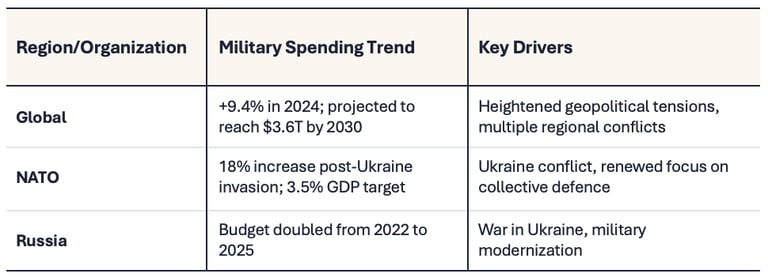
Table 2: Global Military Spending Trends (2024-2030). Sources: SIPRI, Ainvest, NATO. [3, 4, 5]
A .168 Capital Perspective: Real Assets in an Age of Abstraction
At .168 Capital, we view these trends not as isolated events, but as interconnected components of a larger structural shift. The increasing correlation between military spending and the gold price, as identified by Gavekal, is a symptom of a deeper issue: the erosion of trust in abstract financial assets and a renewed appreciation for the enduring value of real, tangible assets.
The Gavekal analysis notes that gold prices have historically moved with an elasticity of approximately 2.5 times that of military budgets [2]. This is not merely a statistical correlation; it is a reflection of the market's recognition that in times of crisis, real assets are the ultimate arbiter of value. The case of Russia, which liquidated a significant portion of its gold reserves to finance its war in Ukraine, provides a stark modern-day example of this principle in action [2].
Our investment philosophy is grounded in this reality. We believe that in a world defined by abstraction and volatility, enduring wealth is built on a foundation of real assets: gold, land, real estate, and essential commodities. These are the assets that cannot be inflated, devalued, or abstracted away by policy decisions. They are the bedrock of economic activity and the ultimate store of value in a world of uncertainty.
The Future of Wealth is Grounded in Reality
The historical link between gold and war is a powerful reminder that in times of crisis, the world reverts to first principles. The current geopolitical landscape, characterized by rising military spending and a structural decline in the value of fiat currencies, is forcing a global reassessment of risk and value. As central banks and institutional investors increasingly turn to gold and other real assets, they are not simply chasing returns, but seeking to preserve purchasing power and anchor their portfolios in a foundation of scarcity and durability.
For investors seeking to navigate this new era, the lesson is clear: the future of wealth belongs to those who ground their portfolios in what is real, durable, and essential. The age of abstraction is giving way to a new era of real-asset scarcity, and gold, as it has for millennia, is once again at the centre of the story.
References
[1] Wikipedia. "Lydian stater." Accessed January 11, 2026. https://en.wikipedia.org/wiki/Lydian_stater
[2] Darcet, Didier. "Gold And War." Gavekal Intelligence Software, December 11, 2025. https://research.gavekal.com/teaser/gold-and-war/
[3] SIPRI. "Unprecedented rise in global military expenditure as European and Middle East spending surges." April 28, 2025. https://www.sipri.org/media/press-release/2025/unprecedented-rise-global-military-expenditure-european-and-middle-east-spending-surges
[4] Ainvest. "Global Defense Spending Surge in 2025–2030." January 9, 2026. https://www.ainvest.com/news/global-defense-spending-surge-2025-2030-identifying-high-conviction-defense-aerospace-stocks-long-term-growth-2601/
[5] NATO. "Defence expenditures and NATO's 5% commitment." December 18, 2025. https://www.nato.int/en/what-we-do/introduction-to-nato/defence-expenditures-and-natos-5-commitment
[6] WisdomTree. "Central Banks, Gold and the Shifting Foundation of Reserves." September 23, 2025. https://www.wisdomtree.com/investments/blog/2025/09/23/central-banks-gold-and-the-shifting-foundation-of-reserves
[7] World Gold Council. "Central Bank Gold Reserves Survey 2025." June 17, 2025. https://www.gold.org/goldhub/research/central-bank-gold-reserves-survey-2025
[8] .168 Capital. "Insights Journal." January 11, 2026. https://168.capital/insights
"As sovereign debt compounds and monetary expansion becomes structural, fiat currencies face sustained pressure on long-term purchasing power. Cash and traditional fixed income absorb this dilution by design. Scarcity-based assets emerge as stabilizers in systems dependent on perpetual expansion." - .168 Capital [8]
The Return of Geopolitical Risk and the Flight to Scarcity
After a multi-decade period of relative stability, the world has entered a new era of geopolitical volatility. Global military spending has surged, reaching a record $2.72 trillion in 2024 and is projected to exceed $3.6 trillion by 2030 [3, 4]. This dramatic increase in defence budgets, driven by conflicts and rising tensions, is a clear signal of a structural shift in the global security landscape.
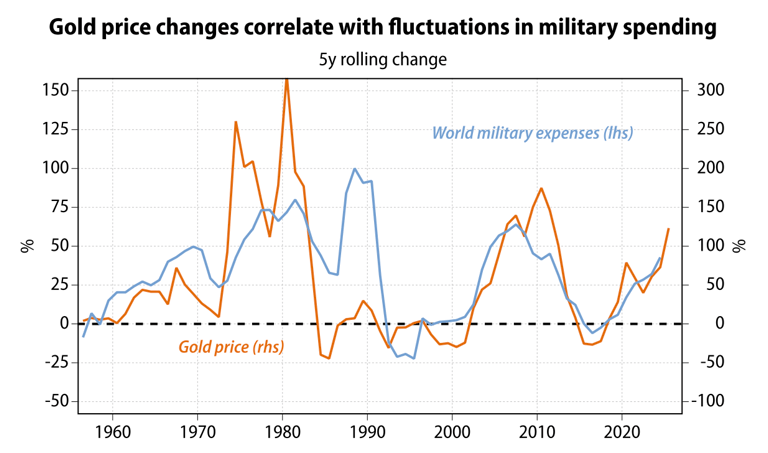
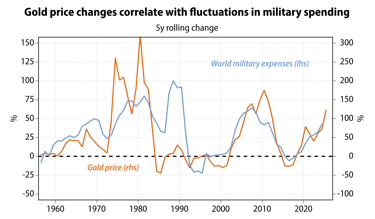
Table 1: "Gold And War." Gavekal Intelligence Software, December 11, 2025 [2]
© .168 Capital 2025
This site is published for informational purposes only. It describes the operational architecture and supply chain framework of 168 Capital and its subsidiaries. Nothing on this page constitutes an offer, solicitation, or invitation to enter into any agreement of any kind. 168 Capital does not solicit counterparties through public channels. All bilateral engagements are established through direct, private contact and are subject to due diligence and the execution of definitive agreements.
SOCIAL MEDIA
Building tomorrows real-asset economy